Operate pgagroal as production infrastructure.
Standard pgagroal underneath. Fleet control, hardened Kubernetes deployment, observability, health-gated upgrades, compliance evidence, and patch delivery around it — with enterprise support available separately.
The control plane is never in the database traffic path. If it is unavailable, your pools continue serving applications.
One pooler is a component. A fleet is an operating model.
Running one pgagroal instance is straightforward. Operating a fleet of them consistently, securely, observably, and safely through upgrades is a different problem.
A single pgagroal instance can be deployed and managed directly. Then more clusters, regions, applications, and teams are added — and the operating cost, not the pooler, is what grows:
- Configuration and image versions drift between deployments.
- Alerting and dashboards become inconsistent.
- Certificates and policies need to be tracked.
- Upgrades turn into manual production events.
- A new CVE means finding, validating, and updating every affected deployment.
- Auditors need evidence, not verbal assurances.
- Support needs diagnostics without sensitive application or database data.
- Deploy
- Observe
- Govern
- Upgrade
- Prove
pgagroal is not the problem — operating infrastructure consistently at fleet scale is. pgAgroal Enterprise is the operating model around the pooler you already run.
Control around the pooler, never inside the data path
The Enterprise control plane attaches alongside standard pgagroal. It manages and configures the pooler — it does not proxy database traffic.
Applications
your services
Standard pgagroal
unmodified upstream pooler
PostgreSQL
your database
pgAgroal Enterprise control plane
- Inventory & drift detection
- Metrics, dashboards & alerts
- Upgrade orchestration
- Audit evidence
- Support diagnostics
- Standard pgagroal remains the pooler.
- Enterprise does not fork it.
- The control plane is outside the data path.
- Temporary control-plane unavailability does not interrupt existing pool traffic.
- Pooler security and correctness fixes go upstream.
Read the full architecture for the attach-alongside model and the trust boundary.
What Enterprise actually solves
Six operational problems that show up as a pgagroal deployment becomes a fleet.
Fleet drift
- Problem
- Different clusters gradually run different image versions, settings, policies, and deployment conventions.
- Mechanism
- Fleet inventory and drift detection make every deviation from the declared baseline visible.
- Outcome
- Inconsistent deployments are found before they become upgrade, security, or support problems.
Kubernetes hardening
- Problem
- Every platform team should not have to independently reconstruct safe deployment defaults.
- Mechanism
- Operator and Helm chart with non-root, read-only-root defaults, dropped capabilities, NetworkPolicies, PodDisruptionBudgets, and Kyverno policy support.
- Outcome
- A repeatable deployment that lines up with your platform standards.
Upgrade risk
- Problem
- A pooler upgrade touches a critical path between applications and PostgreSQL.
- Mechanism
- Canary rollout, health gates, and automatic rollback stage the change and back it out on failure.
- Outcome
- Upgrades become controlled operational changes, not manual fleet-wide events.
Vulnerability response
- Problem
- A newly disclosed vulnerability creates an inventory and patch-distribution problem across every deployment.
- Mechanism
- Signed artifacts, SBOMs, a VEX policy, a CVE-response SLA, and fleet patch delivery.
- Outcome
- You can determine exposure and deliver validated updates through a defined process.
Compliance evidence
- Problem
- Dashboards and verbal descriptions do not constitute durable audit evidence.
- Mechanism
- Audit export, signed release materials, inventory records, and deployment evidence.
- Outcome
- Security and compliance teams receive defensible records.
Safe support
- Problem
- Infrastructure teams need vendor help without sending raw credentials, SQL, or sensitive database contents.
- Mechanism
- A redacted support bundle built for operational diagnostics.
- Outcome
- Faster support with a smaller data-exposure surface.
What Enterprise includes
The same standard pgagroal, plus an operations layer grouped by the concern it addresses.
Deploy consistently
One hardened, declarative way to run the pooler everywhere.
- Kubernetes operator and Helm chart
- Non-root, read-only root filesystem, dropped Linux capabilities
- NetworkPolicies and PodDisruptionBudgets by default
- Kyverno policy support
See the fleet
Know what is running, and where it has drifted.
- Fleet inventory across every pooler instance
- Version and configuration drift detection
- Curated Grafana dashboards and Prometheus alerts
- Dashboard and alert drift protection
Upgrade safely
Change the critical path without a manual fleet-wide event.
- Canary deployment and health gates
- Automatic rollback on failure
- Digest-pinned artifacts
- Controlled patch delivery
Respond and prove
Answer the auditor and the CVE with records, not assurances.
- Signed artifacts, SBOM, and VEX policy
- CVE-response SLA
- Audit export
- Redacted support bundle
Migrate and procure
Get in from PgBouncer, and buy the way you already buy.
- PgBouncer configuration import and migration report
- AWS Marketplace or direct subscription
- Offline, air-gapped delivery bundle
- Digest-pinned, signed delivery
Operational evidence, not another opaque control plane
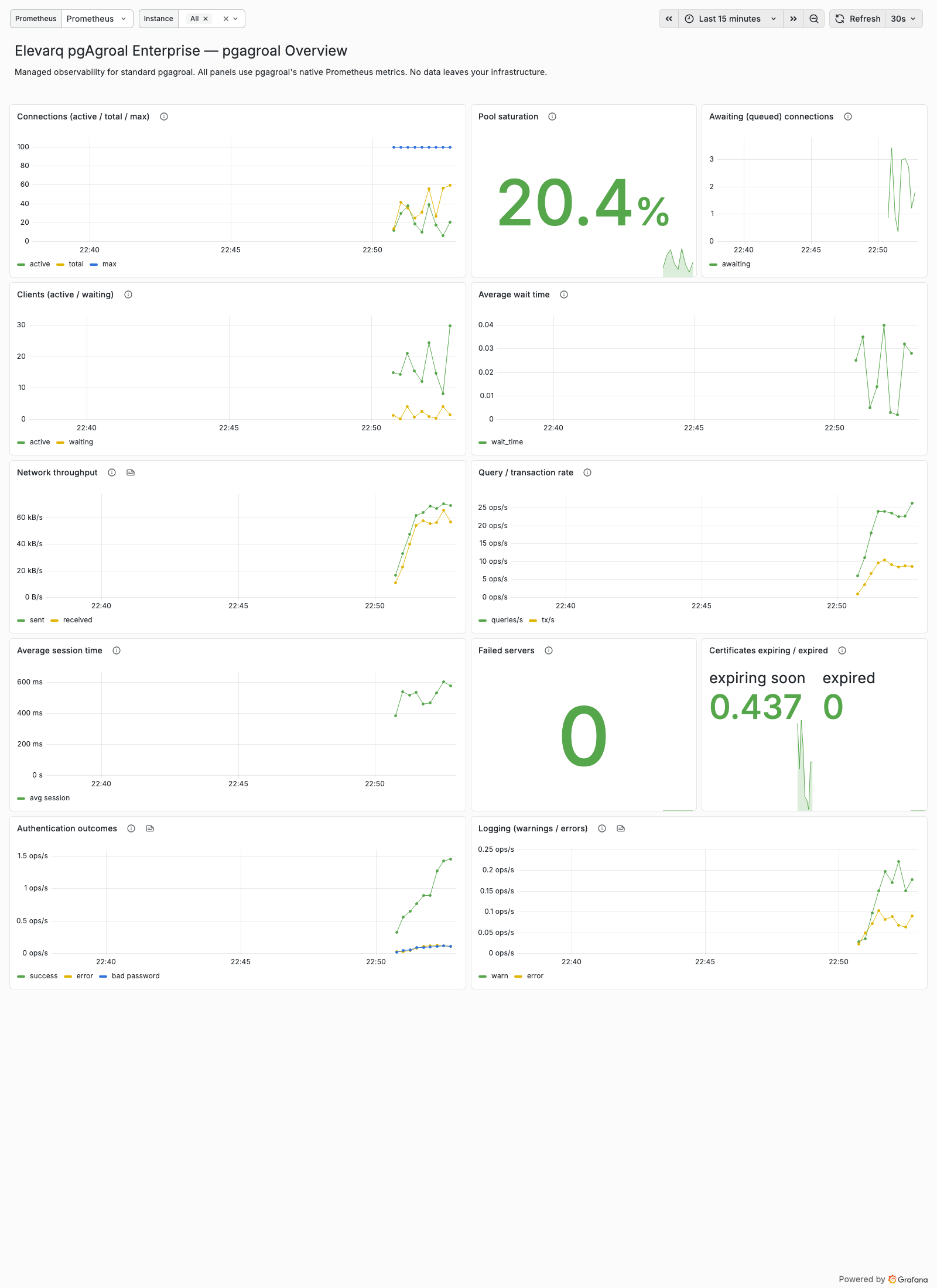
Curated Grafana dashboards ship with Enterprise so the fleet's state is legible — connections, pool saturation, query rate, sessions, and auth and certificate health.
Free pgAgroal Container vs pgAgroal Enterprise
The free container is production-ready and self-managed. Enterprise adds the operations layer around it — the same pooler underneath.
| Capability | Free pgAgroal Container | pgAgroal Enterprise |
|---|---|---|
| Standard pgagroal pooler | Included. | Included. |
| Production-ready, hardened container defaults | Included. | Included. |
| Signed releases and SBOM | Included. | Included.+ VEX, CVE-response SLA, fleet patch delivery |
| Operating model | Self-managed | Included.Managed operations layer |
| Kubernetes operator, PDBs, NetworkPolicies, Kyverno policies | Not included. | Included. |
| Fleet inventory and configuration drift detection | Not included. | Included. |
| Curated Grafana dashboards and Prometheus alerts | Not included. | Included. |
| Health-gated upgrades with automatic rollback | Not included. | Included. |
| Audit export and redacted support bundle | Not included. | Included. |
| PgBouncer migration tooling | Not included. | Included. |
| Support | Community / optional contract | Sold separately — contact sales |
| Procurement | Docker Hub — free | Included.Cloud marketplace or direct |
| Price | Free | Commercial subscription |
Choose the free container when your team wants to operate pgagroal directly. pgAgroal Container →
Choose Enterprise when you need to operate multiple deployments with consistent policy, observability, upgrades, and compliance evidence.
Move from PgBouncer with an explicit migration report
Migration is reviewable, not a black box.
- Import and translate the configuration that maps directly.
- Identify settings that do not map, so nothing is assumed.
- Produce a migration report you can review before production rollout.
The report surfaces differences for review; it does not claim automatic equivalence between the two poolers.
Procure the way you already buy — deploy in your own environment
However you procure, the pooler and control plane run on your Kubernetes, not ours.
AWS Marketplace
Procure through an existing AWS relationship on your cloud invoice and contract path, then deploy into your own EKS environment.
Available now
Direct subscription
For on-premises and private cloud: a signed, digest-pinned delivery bundle with a defined update and patch process.
Air-gapped
An offline bundle — images, charts, dashboards, policies, and SBOMs — with no dependency on a continuously connected SaaS control plane.
AWS Marketplace is currently available. Azure and Google Cloud marketplace availability is planned, not yet available. Deployment always remains in your environment.
Enterprise support is available as a separate purchase, not bundled into the subscription. Talk to sales about support →
Enterprise operations without a proprietary pooler fork
pgAgroal Enterprise does not reserve pooler correctness or security fixes for commercial customers. Standard pgagroal remains standard pgagroal, and fixes to the pooler go upstream. The commercial product provides the operational system around it: deployment, fleet control, observability, upgrades, evidence, patch delivery, and procurement.
The control plane is not a fork and not in the data path — if it is unavailable, your pools keep serving traffic, and the open container stays free and source-available.
Operate pgagroal consistently across production.
Use the free container when you want to manage pgagroal directly. Use pgAgroal Enterprise when your organization needs a managed operating model around the fleet, with support available when you want it.